


The video of the presentation of the book “Gaia and Philosophy” is now available
TERRA has released a video presentation of the book “Gaia and Philosophy”, by Lynn Margulis and Dorion Sagan – an invitation to think deeply and at length about the planet we inhabit.
In April, on the occasion of World Earth Day, we discussed “Gaia and Philosophy”, a work that offers a profound reflection on the interdependence between living systems and the environment. We now share this unfiltered conversation – a meeting of ideas where philosophy and science intersected to consider the future of the planet.
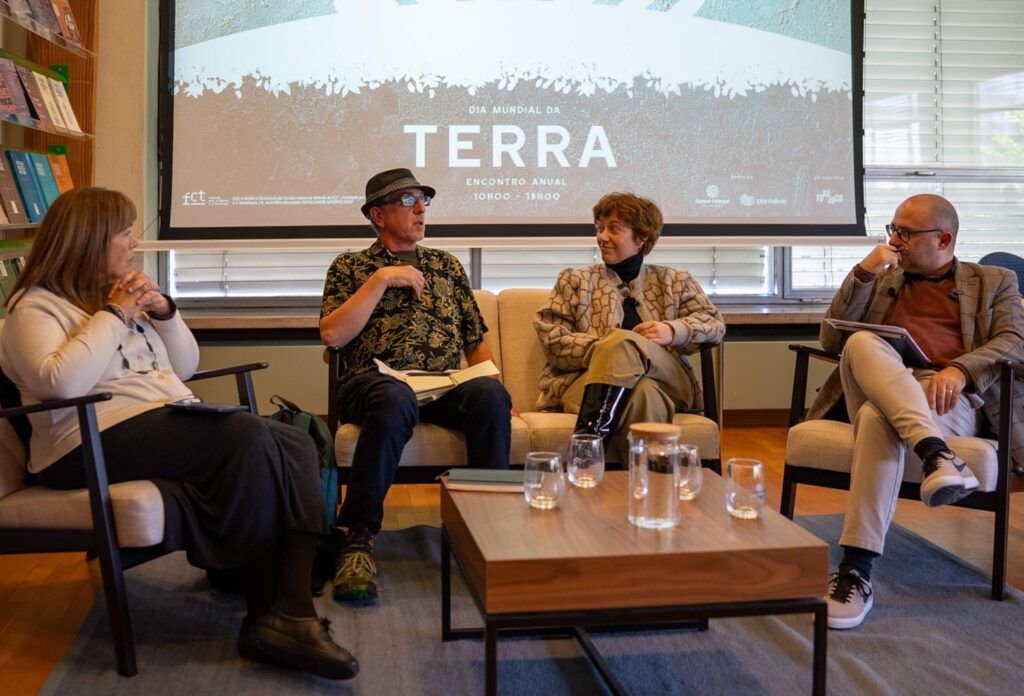
The presentation panel brought together Ricardo Santos, researcher at ISAMB – Instituto de Saúde Ambiental, Teresa Ferreira, President of the TERRA Coordinators Council, Patrícia Azevedo da Silva, translator, editor, and anthropologist, and Dorion Sagan, author and philosopher.
The conversation focused on philosophy and ecological thinking, with Dorion Sagan highlighting the impact of Gaia theory on modern ecological thinking and its relevance to the development of new environmental practices. Teresa Ferreira and Patrícia Azevedo da Silva reflected on how these ideas can be applied in the current context, promoting more effective public policies. Ricardo Santos moderated the discussion, guiding the debate on the philosophical implications of Gaia theory in science and society.
Because thinking about the planet is not a luxury – it is an urgent necessity. Watch, listen, question:
Combining philosophical and ecological approaches, this work, which was supported by the TERRA Associate Laboratory, invites us to rethink humanity’s relationship with the Earth, offering new perspectives on our place in the world. Published by Fora de Jogo, “Gaia and Philosophy” was translated by Patrícia Azevedo da Silva (Fora de Jogo), revised by João Queirós and Ricardo Santos (ISAMB/TERRA), who also wrote the afterword.
Gaia and Philosophy
The endosymbiosis theory, put forward by Lynn Margulis, is now widely accepted and included in biology textbooks. However, her article on the origin of eukaryotic cells was rejected more than fifteen times before being published.
In the 1970s, Margulis collaborated with James Lovelock on the Gaia hypothesis, which proposes that the Earth functions as a living organism, with self-regulating mechanisms that sustain life. The name “Gaia” was suggested by William Golding, although Lovelock revealed that he initially heard “Gyre” — a curiosity that raises the question: would the reception have been different without the New Age connotations?
Margulis stood out for her collaborative approach and sensitive view of the microbial world, reflected in her intense scientific and artistic production with her son Dorion Sagan. Considered one of the great thinkers in the life sciences, her legacy is comparable to that of Darwin.
Partilhe esta notícia:
Share this news: