


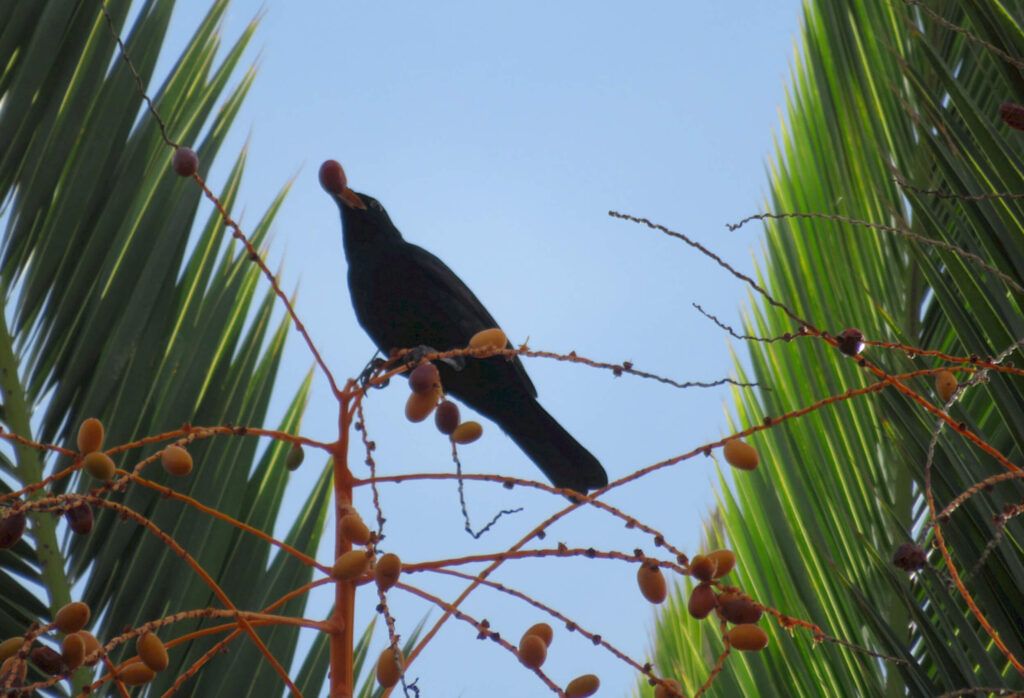
Blackbird eating a Canarian palm fruit © Sara Mendes
Study by CFE/TERRA researchers shows that seed-dispersing birds help plants facing the climate changes
A research published in the journal New Phytologist, led by researchers from the Centre for Functional Ecology (CFE) and the TERRA Associate Laboratory, has demonstrated the role of seed-dispersing birds in plants’ fight against climate change, but warns of the risk of exotic species spreading.
The island of Tenerife, in the Canary Islands, is the highest point in the Atlantic Ocean and was the study site for CFE/TERRA researchers Sara Mendes and Rúben Heleno to observe the role that birds play in dispersing plant species to altitudes higher than those where they are usually found.
According to the authors, one of the most important results was that they found the seeds of eleven plant species being dispersed by the animals (in their droppings) to altitudes higher than those where the adult plants currently exist.
“The results obtained indicate that seed-dispersers connect the different vegetation floors, eating fruit and dispersing viable seeds along ‘corridors’ that run from the beach to the mountain top. In this way, they allow the next generations of plants to germinate and grow at higher altitudes, escaping the harsh climate changes in the lower zones (subject to more drought and heat)” reveals Sara Mendes, first author of the study.
Although seed dispersal is a way of maintaining plant species that would otherwise be under threat from climate change, it also puts in jeopardy the conservation of ecosystems where exotic plants did not previously exist, particularly in mountainous regions.
The study emphasises the importance of protecting seed-dispersing animals, which are essential for the survival of plants in a changing climate, and reinforces the urgency of controlling the spread of exotic species. “Protecting seed-dispersers and investing in conservation strategies to mitigate the invasion of exotic species are crucial steps to safeguard the integrity of mountain ecosystems” underline the authors.
To find out more and read the scientific article “Climb forest, climb: Diverse disperser communities are key to assist plants tracking climate change on altitudinal gradientes”, you can access this link: https://nph.onlinelibrary.wiley.com/doi/10.1111/nph.20300
Source: noticias.uc.pt
Partilhe esta notícia:
Share this news: