


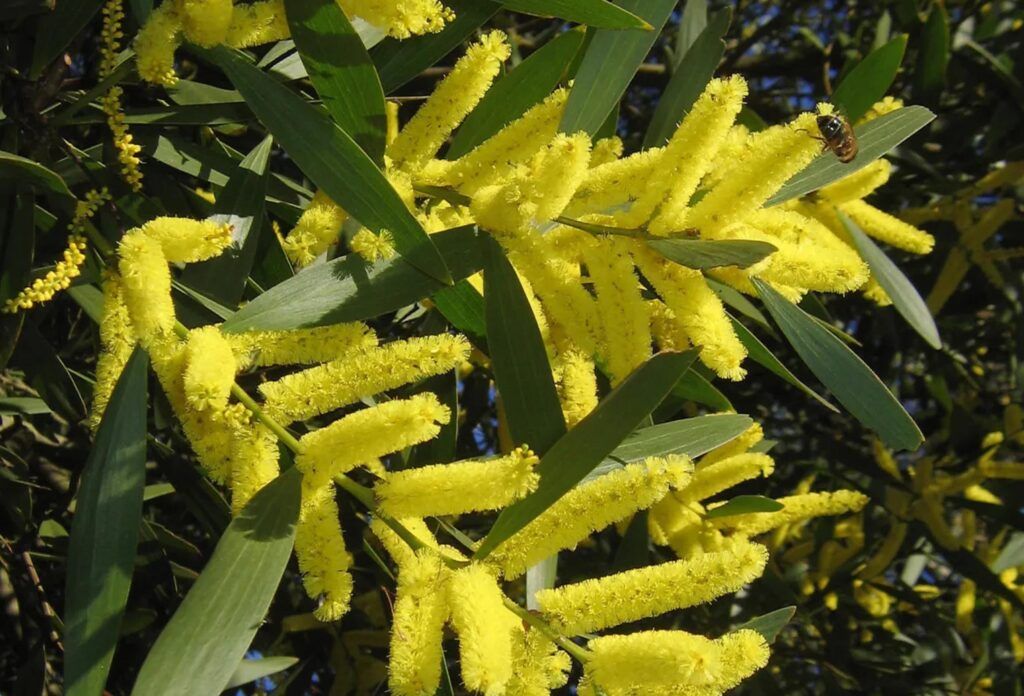
Acacia longifolia © Sergio Chozas site flora.on
Scientists in Portugal Confirm the Safety of Using the Australian Wasp to Control Invasive Acacia Spread
The study, led by Francisco López-Núñez, a researcher at the Centre for Functional Ecology (CFE) of the Faculty of Sciences and Technology of the University of Coimbra (FCTUC), analyzed 154 plant species, approximately 45,000 galls, and 11,000 insects along the central coast of Portugal. The research also focused on building and analyzing complex trophic networks involving plants, galls, and parasitoids. This allowed for a comprehensive evaluation of both the direct and indirect ecological effects of the wasp on local ecosystems. The findings confirmed that this biological control agent is an effective and ecologically sound solution for managing acacia invasions without compromising native biodiversity.
Originally from Australia, Acacia longifolia has aggressively invaded several regions of Portugal, displacing native vegetation and threatening biodiversity. The introduction of Trichilogaster acaciaelongifoliae , a species-specific gall-inducing wasp that feeds on the reproductive structures of the acacia, is aimed at limiting the plant’s ability to spread. The study employed an innovative methodology combining species interaction networks with a before-after-control-impact (BACI) experimental design, enabling precise assessment of the wasp’s ecological effects. Results indicate a significant reduction in the density of the invasive plant, with minimal impact on native species or overall ecosystem function—demonstrating that biological control can be both safe and effective.
The TERRA Associate Laboratory, which plays a leading role in environmental research and management, closely followed the progress of the study. The project aligns with TERRA’s core research areas in ecological restoration and invasive species control. The success of the study highlights the value of integrated scientific approaches in addressing today’s environmental challenges. Collaboration among academic and scientific institutions proved essential for ensuring that biological control practices are implemented responsibly and adapted to local ecological conditions.
The research presents promising results for acacia control in Portugal and underscores the importance of sustainable alternatives to herbicides or other chemical methods, which can disrupt ecological balance. The controlled introduction of T. acaciaelongifoliae has already led to a noticeable decrease in acacia populations, facilitating the recovery of native vegetation and ecological conditions. Crucially, the study demonstrated that this wasp does not produce adverse environmental effects, reinforcing the viability of biological control as a sustainable management practice.
However, the researchers emphasize the importance of continuous monitoring. Despite the demonstrated benefits, any species introduction—even one intended for biological control—must be carefully managed to avoid long-term ecological imbalances. This study serves as a clear example of how science and innovation can be effectively applied to environmental problem-solving, offering not only a concrete solution for acacia control, but also illustrating the importance of integrative approaches that consider species interactions and broader ecological impacts.The collaboration between universities, research centers, and the TERRA Laboratory highlights the importance of cooperative research in the search for sustainable solutions that protect biodiversity and promote ecological resilience in Portugal. The success of this study provides new insights into the potential of biological control and paves the way for similar approaches in other regions worldwide facing challenges from invasive plant species.
Partilhe esta notícia:
Share this news: