


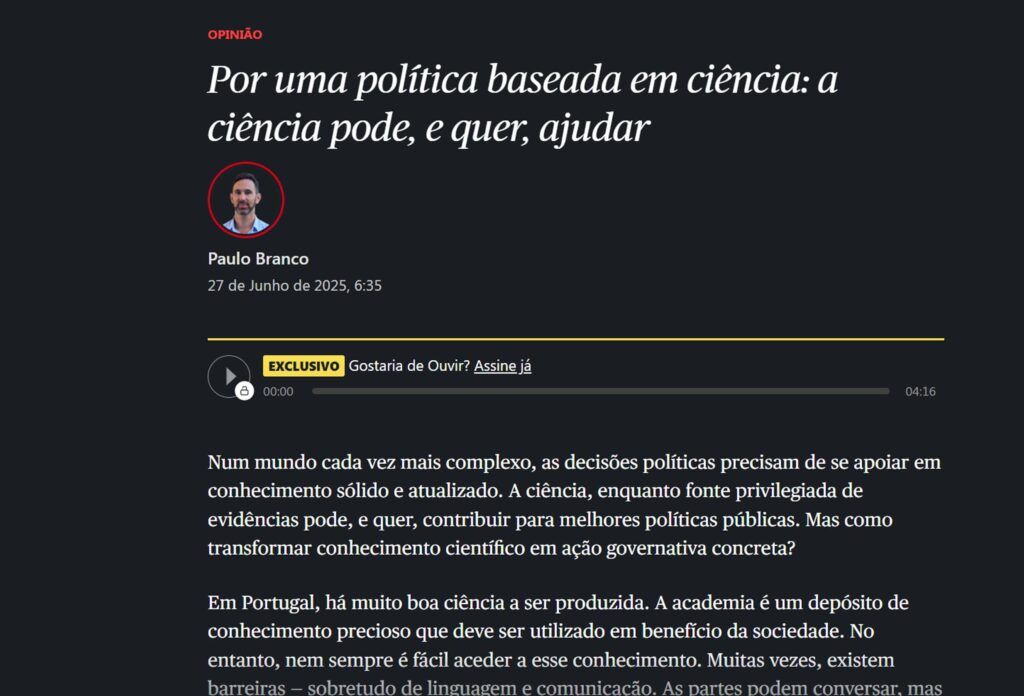
“Science Can — and Wants to — Help!”: Público Opinion Piece Reinforces TERRA’s Commitment to Evidence-Informed Public Policy
On June 27, the Executive Director of the TERRA Associate Laboratory published an opinion article in Público that clearly and boldly reinforces the urgent need for a deeper articulation between science and public policy in Portugal. Entitled “Por uma política baseada em ciência: A ciência pode, e quer, ajudar!”, the piece delivers a powerful call to action, highlighting both the challenges and the opportunities in building governance supported by rigorous, up-to-date, and socially relevant knowledge.
In a world undergoing constant change and marked by increasing complexity, science, according to the author, stands as “a privileged source of evidence” to inform political decisions. However, he warns, “information is of little use if not correctly interpreted; using it poorly can be worse than not using it at all.”
In this context, the article underscores the importance of interface structures between science and policymaking, capable of interpreting, synthesizing, and translating scientific knowledge into accessible and actionable language.
“In Portugal, institutions already exist with this mission — such as the Associate Laboratories — which work daily with leading researchers to push the boundaries of knowledge. However, these structures, guided by the ethics and integrity that characterize scientific activity, do not aim to influence policy — only to support it,” writes the author.
Embracing this mission, the TERRA Associate Laboratory has actively pursued a strategy of closer engagement with public administration, including the creation of a structured interface — the Science Policy Interface (SPI) — and the signing of memoranda of understanding with several national public entities, namely APA, ApC, AGIF, DGADR, DGAV, DGS, DGT, GPP, ICNF, and IPMA. This cooperation was formally celebrated during the event “Transformative Knowledge: Science and Policy for TERRA”, held on June 27 at Teatro Thalia.
The article also cautions against the risks of science being discredited and stresses the need for the academic community to be more visible in public debate: “All of us, as scientific agents, have a duty to reinforce the credibility of science and to make ourselves available to contribute to the common good.”
Rejecting the isolation of knowledge, Paulo Branco advocates for a responsive academic sector, one capable of engaging directly with decision-makers and contributing to laws, policies, and practices that are more appropriate, feasible, and aligned with the pressing challenges of sustainability and social justice.
“Science is here. It’s available. And it wants to help,” the article concludes — a clear appeal for future governance to walk hand-in-hand with knowledge and those who produce it.
Through this act of scientific citizenship, TERRA reaffirms its role as an agent of social and institutional transformation, and as a catalyst for informed, effective, and human-centered public policy.
Partilhe esta notícia:
Share this news: