


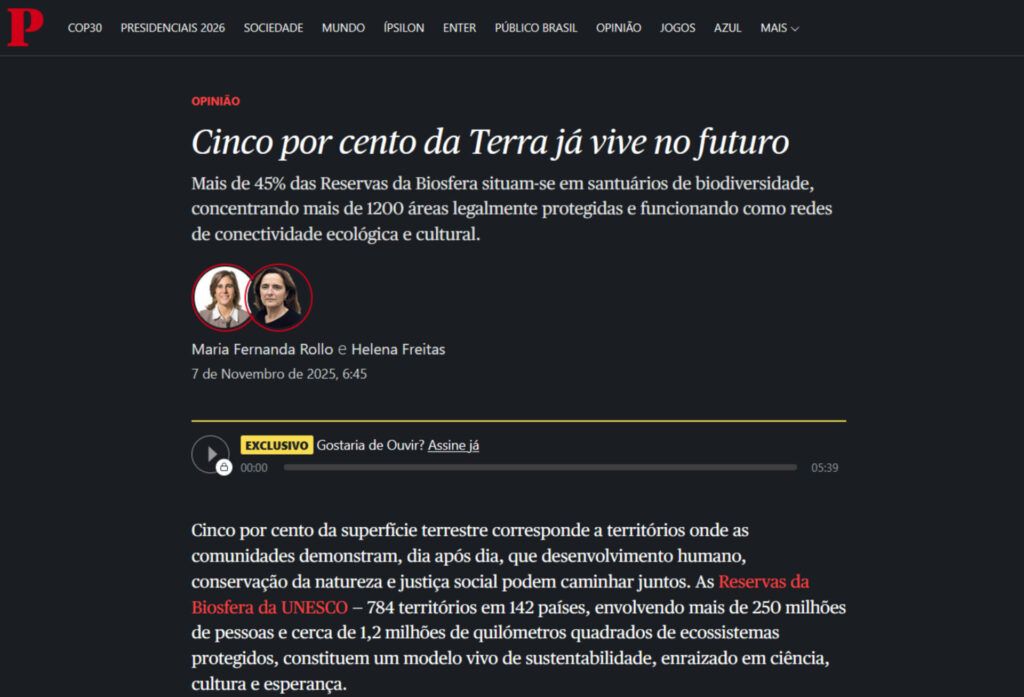
Helena Freitas and Fernanda Rollo (CFE/TERRA) highlight the role of Biosphere Reserves as territories of socio-ecological innovation in an article in Público
In an article published in Público, researchers from CFE/TERRA reflect on the role of Biosphere Reserves in ecological transition, advocating for public science that is rooted in the territory and oriented towards sustainability.
The coordinator of the Centre for Functional Ecology (CFE), Helena Freitas, and the coordinator of the CFE’s “History, Territories and Communities” Research Group, Maria Fernanda Rollo, along with members of the TERRA Associate Laboratory, have signed an opinion piece published in the Público newspaper entitled “Cinco por cento da Terra já vive no futuro” (“Five percent of the Earth already lives in the future”).
In the text, the authors highlight that five percent of the Earth’s surface corresponds to UNESCO Biosphere Reserves — “784 territories in 142 countries, involving more than 250 million people and around 1.2 million square kilometers of protected ecosystems,” the article states. These territories are presented as living models of sustainability, rooted in science, culture, and hope, where human development, nature conservation, and social justice go hand in hand.
The article follows the 5th World Congress of Biosphere Reserves, held under the theme “Living together on one Planet,” which brought together more than 1,200 participants from 130 countries. The meeting marked the 50th anniversary of UNESCO’s Man and the Biosphere (MAB) programme and defined a new strategic framework for the next decade, with the goal of reaching 1,000 Biosphere Reserves by 2035, with a special focus on urban, coastal, and island areas.
“Valuing Biosphere Reserves means celebrating the communities that live and build the future every day: farmers and fishermen, scientists and teachers, young people and local authorities, all those who, in 5% of the planet, have already proven that another way of inhabiting the Earth is possible. Only 95% left to go,” write the authors.
In this text, Helena Freitas and Maria Fernanda Rollo (CEF/TERRA) reflect on the territories that are already implementing sustainable, inclusive, and resilient development models—and on the role of science as a public good in building these futures. Through a critical and inspiring approach, the article highlights the importance of transdisciplinary research, territorial cohesion, and the valorization of knowledge as pillars for addressing the environmental and social challenges of our time.
Read the full article in Público: publico.pt/2025/11/07/ciencia/opiniao/cinco-cento-terra-ja-vive-futuro-2153396 (in Portuguese).
Partilhe esta notícia:
Share this news: