


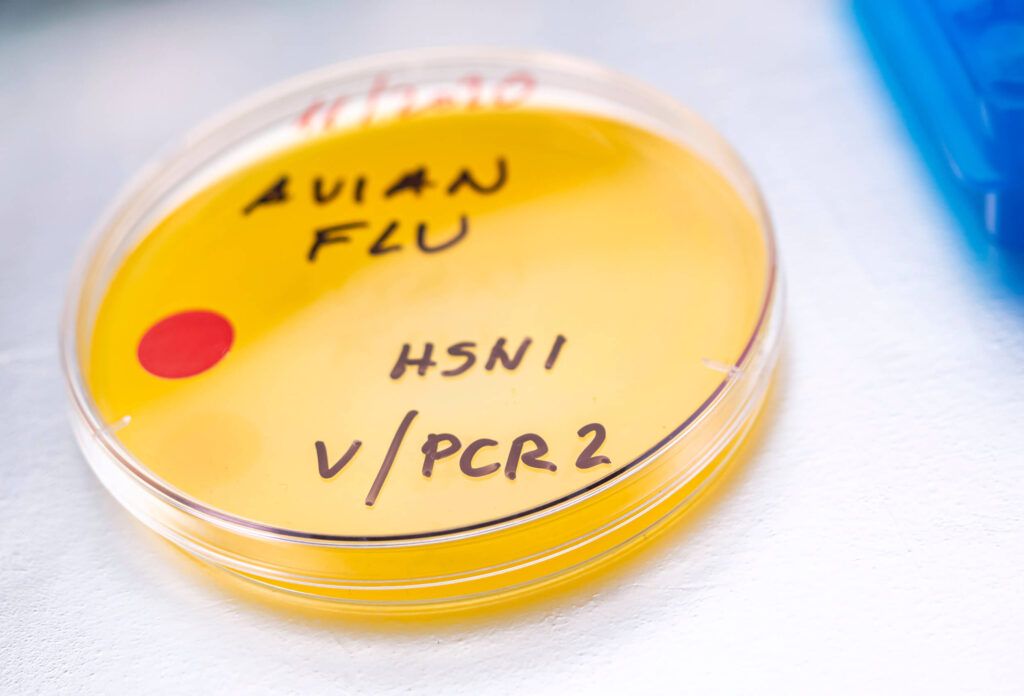
ISAMB/TERRA Expert Highlights the Impact of Avian Influenza on Public Health and Its Pandemic Potential
In response to recent reports of avian influenza outbreaks in Portugal, Professor Francisco Antunes from ISAMB/TERRA emphasizes the global risk of the H5N1 virus and the need for an integrated approach to combat it
Avian influenza remains a global public health threat, with the potential to evolve into a pandemic, warns Professor Francisco José Nunes Antunes, a researcher at the ISAMB and a member of the Associate Laboratory TERRA. The increasing circulation of the H5N1 virus in both wild and farmed birds, as well as its transmission to other animals and occasionally to humans, underscores the importance of an integrated approach to address this threat.
Pandemic Potential?
The first cases of H5N1 avian influenza appeared in Hong Kong in 1997, and were controlled by culling 1.5 million birds. However, in 2003, the virus emerged with panzoonotic characteristics, affecting domestic birds with alarming economic consequences and a potential for interspecies transmission that led to human infections with a mortality rate of about 50%. According to the World Health Organization (WHO), H5N1 poses a significant global health security threat with substantial pandemic potential. Despite having caused only 876 human cases and 458 deaths by 2023, it is estimated that in the context of a pandemic, it could result in between 5 to 150 million deaths globally.
Professor Francisco Antunes notes that although a pandemic caused by H5N1 is unlikely due to its low efficiency in human-to-human transmission, the risk should not be underestimated. The history of influenza pandemics, such as the Spanish flu (1918-1919), which caused 20 to 40 million deaths, and the Asian flu (1957-1958), which resulted in 1 to 4 million fatalities, demonstrates the devastating impact a mutation or genetic recombination of influenza viruses can have on the global population. He also highlights the recent detection of H5N1 in the United States and other countries, in dairy cattle and pigs, raising the risk of reassortment between avian and human viruses, potentially creating new species with pandemic potential.
In terms of human infection with the H5N1 influenza virus, Francisco Antunes identifies several enigmas that challenge the scientific community:
- Despite several massive outbreaks in farmed birds in densely populated areas and consequent human exposure to the virus, the number of human cases has remained relatively low, similar to the 1997 outbreak in Hong Kong. Some of these cases were mildly symptomatic or asymptomatic infections, suggesting inefficient transmission from infected poultry to humans.
- In the Hong Kong cases in 1997, despite most being related to exposure to live birds in markets, around 30% of cases did not have an identified source of infection.
- A significant number of cases have been recorded within households, making it difficult to determine whether this represents infection from a common environmental source or if it is limited to human-to-human transmission.
- There has been a low incidence and mortality rate among individuals over 40 years of age. Given that most H5N1 cases are associated with close contact with birds and other animals, and contaminated environments, this is insufficient to explain the epidemiology of the disease in humans, suggesting that genetic susceptibility factors and unknown host resistance mechanisms may be involved.
Integrated “One Health” Approach
The pandemic potential of H5N1 necessitates greater surveillance in both animal and human populations and a coordinated global response to prevent future pandemics.
As highlighted by Professor Madalena Lordelo (LEAF/TERRA) in an article published yesterday on TERRA’s website regarding the importance of an integrated approach to combat avian influenza outbreaks (read the article here), Professor Francisco Antunes, an expert in infectious diseases, also emphasizes that the “One Health” concept is essential for effectively addressing avian influenza, preventing transmission between species, reducing spread among animals, and preventing human infections.“Although the risk of infection for the general population is low, the risk is moderate for those exposed to birds, mammals, or contaminated environments,” underscores Francisco Antunes.
The Professor also notes that while vaccines for H5N1 avian influenza are available for chickens, poultry are not routinely vaccinated due to the limited efficacy and lack of ongoing vaccination programs. For humans, several H5N1 vaccines are available or under development for occupational risk groups, but they are not recommended as a global strategy due to the low number of human infections. Furthermore, “the H5N1 influenza virus undergoes continuous mutations, meaning the effectiveness of a vaccine depends on the circulating strain and may not be effective in a future H5N1 pandemic.” However, the Professor reveals that laboratories are preparing for the rapid production of large quantities of an updated vaccine specific to a future pandemic strain.
While a pandemic may be unlikely, the economic, ecological, and public health impacts are already a reality. To minimize risks, Francisco Antunes emphasizes the need for global surveillance, particularly in populations where animal-to-animal transmission occurs (poultry and dairy cattle) and close monitoring of both animals and humans.
Partilhe esta notícia:
Share this news: