


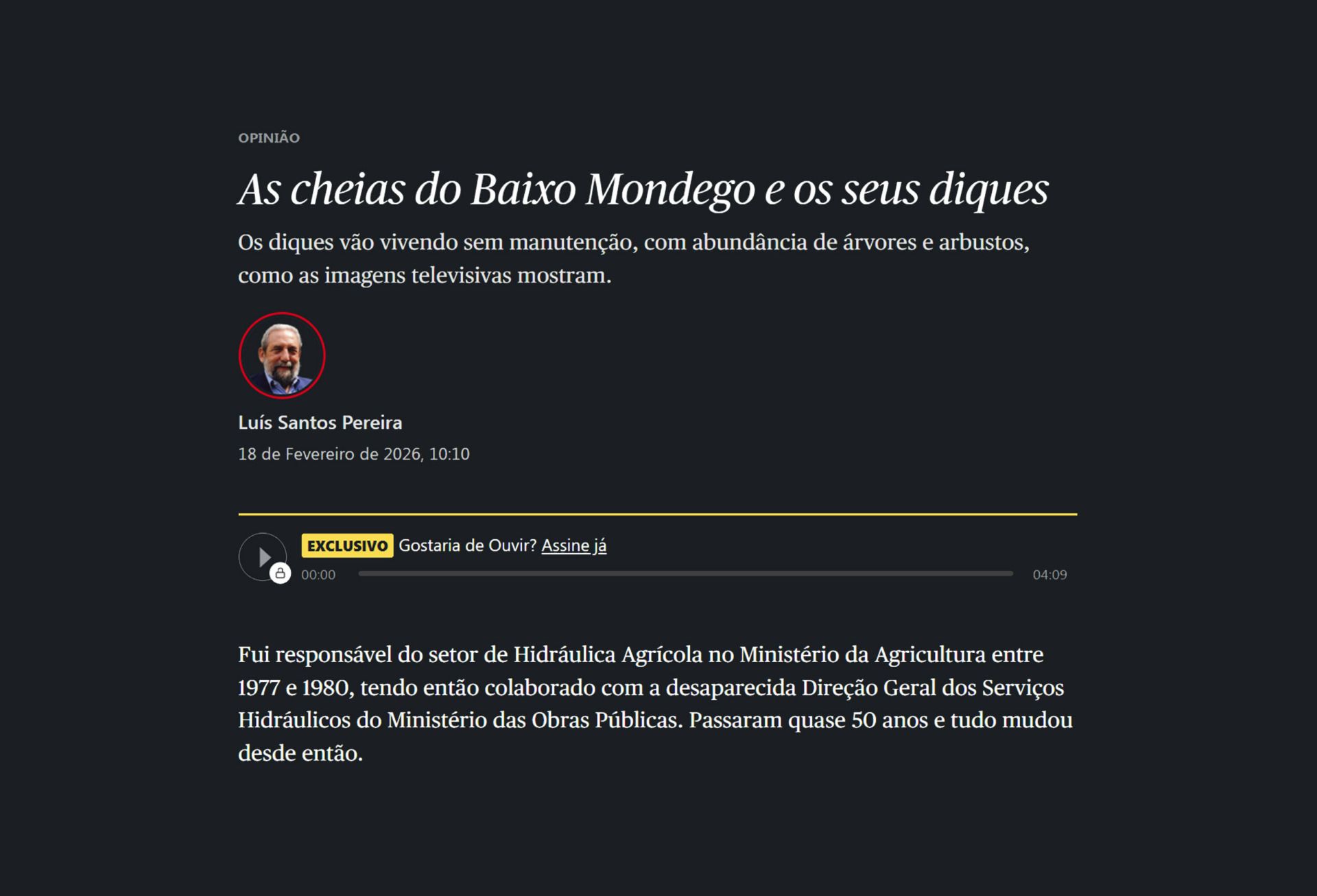


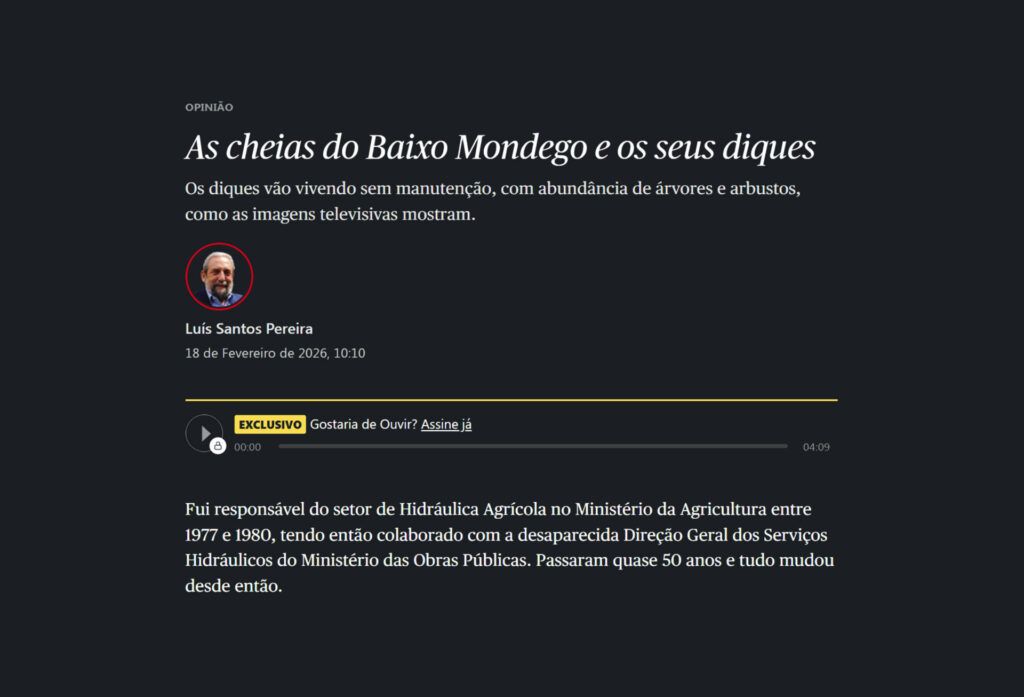
LEAF/TERRA researcher warns of risks to the Baixo Mondego dykes in an article published in Público
Researcher Luís Santos Pereira, member of LEAF – Linking Landscape, Environment, Agriculture, and Food and of the TERRA Associate Laboratory, published an opinion piece in the Público newspaper analyzing the recent floods in Baixo Mondego and warning of structural and institutional weaknesses in the management of the region’s dikes.
With a career spanning several decades in agricultural hydraulics, Luís Santos Pereira recalls that he was responsible for the Agricultural Hydraulics sector at the Ministry of Agriculture between 1977 and 1980, during which time he collaborated with the then Directorate-General for Hydraulic Services of the Ministry of Public Works.
In an article recently published in Público, the LEAF/TERRA researcher acknowledges that irrigation and drainage systems in floodplains have evolved positively, but warns about the state of the dikes, where lack of maintenance and the proliferation of trees and shrubs pose significant risks.
Nationally and internationally recognized in the field of Rural Engineering, particularly irrigation, drainage, and water management, researcher Luís Santos Pereira explains that, although vegetation can reduce erosion and improve the landscape, its uncontrolled presence slows down runoff, raising water levels during floods and increasing the risk of overflow. He adds that roots create infiltration tunnels that compromise the stability of embankments, accelerating the deterioration of dikes.
The researcher identifies the main flaw as being the lack of an institution dedicated to monitoring and conserving the Mondego dykes and the floodplains of its tributaries. He argues that Portugal continues to react impulsively instead of planning for foreseeable emergencies, and calls for a participatory approach involving local communities and farmers.
Full article at https://www.publico.pt/2026/02/18/opiniao/opiniao/cheias-baixo-mondego-diques-2165136 (in Portuguese)
Partilhe esta notícia:
Share this news: